

[ad_1]
AUSTIN, Texas – Austin’s summers are hot. But this heat is not felt everywhere in the city, as anyone who stews in a parking lot or has cooled off under a tree knows.
The University of Texas at Austin is working with the city of Austin, community groups, and East Austin residents to find out where hot temperatures are affecting people the most – and to come up with solutions to cool those places down.
UT is one of four institutions selected by the National Oceanic and Atmospheric Administration to lead research projects focused on combating extreme heat in urban environments.
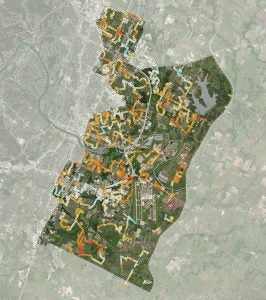
A map of afternoon temperatures collected in Austin as part of the CAPA Heat Watch program in August 2020. Blue indicates the coolest temperatures. Red indicates the hottest temperatures. Credit: CAPA Strategies.
“This helps businesses and communities, and it helps students develop a purpose for their research,” said project leader Dev Niyogi, a professor at the UT Jackson School of Geosciences and the Cockrell School of Engineering. “You’re not just trying to come up with an analysis or a plot. It’s a project where what we do means a better life for someone if we do it right. “
The two-year project builds on an Austin heat map created by the CAPA Heat Watch program last year and has three main goals: to create dynamic heat maps that show, in addition to actual temperature measurements, how people experience the heat; Using these maps to develop strategies for cooling temperature hotspots; and finally, presenting the data and potential solutions to community members and city decision makers.
The project team includes researchers from the UT School of Architecture, LBJ School of Public Affairs, and UT Health Austin, as well as geoscientists and engineers. the East Austin Community Health Advocacy Group, Go Austin / Vamos Austin; and the Austin Sustainability Bureau.
The project is part of UT’s Planet Texas 2050 Bridging Barriers initiative, an interdisciplinary research effort that works to build more sustainable communities in Texas in the face of climate change and a booming population, and to share the benefits of its research with the world.
The temperature measurements start at the beginning of July and last until summer.
The temperature map will cover the entire city, but the project team will focus on collecting public input and making improvements in East Austin, where residents are more likely to encounter hotspots.
 A vehicle used to collect temperature data in Austin during the 2020 CAPA Heat Watch program campaign. Credit: City of Austin.
Summer brings high temperatures across Texas. But cities tend to get hotter because roofs, streets and other structures absorb more heat than less developed land. Thus, a person’s immediate surroundings can drastically change the temperature that person actually feels.
Using a combination of satellite data, ground sensors, and computer models, the heatmaps will be able to provide an overview of the temperature landscape, which can range from all of central Texas to a single street, with temperature readings from every 1,000 square feet to every 3-10 Square feet.
But dimensions and models do not give a complete picture and can even collide with community experiences. To ensure that temperature readings and community experiences are coordinated, the project team will include input from residents from the start, participate in discussions about temperature hotspots in their communities, and receive feedback on temperature maps.
“We can’t figure out the solutions if we can’t connect,” said Marc Coudert, an Austin environmental program manager and a member of the project team.
There are a number of ways to reduce heat in specific areas, from landscaping to laying light-colored walkways. To ensure that any proposed solutions will hold up over time, the researchers will examine how potential improvements will affect local temperatures in the coming decades.
The project is specifically designed to help the Austinites overcome the heat. But people around the world could benefit from the insights and data gathered during the study, Niyogi said. To this end, the researchers will not only present their results to the Austin City Council and other local decision-makers, but also share their findings with international colleagues in webinars and workshops.
[ad_2]
